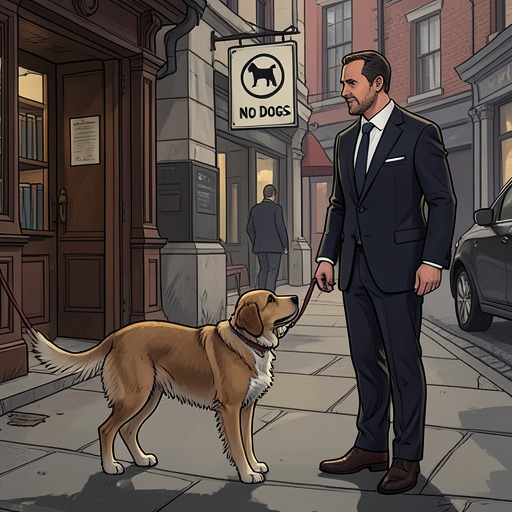
Cemetery dog ban
Lessons in ChemistryThe Cemetery dog ban is an explicit prohibition on dogs entering the cemetery, not merely a requirement that they be kept on a leash. It stands alongside the city’s leash law, and its enforcement turns Six-Thirty’s presence at Calvin Evans’s grave into a public point of conflict. The rule is later lifted after the groundskeeper’s conduct becomes news and Six-Thirty is credited with saving a man’s life.
The rule and its setting
Signs encircle the cemetery and prohibit dogs from entering at all. That restriction is stricter than the city’s new leash law: a dog on a leash would still be barred from the grounds. The distinction matters at Calvin Evans’s funeral, where Elizabeth Zott stands at a distance from the gathering with Six-Thirty beside her, and the dog is not on a lead. To observers among the scientists, this is another instance of Elizabeth and Calvin behaving as if rules do not apply to them. The ban is thus presented both as a straightforward posted restriction and as part of the social judgment directed at the couple.
The funeral makes the rule conspicuous because Six-Thirty is not simply accompanying Elizabeth on an ordinary visit. The dog is at Calvin’s grave while Elizabeth struggles to approach the coffin, and his presence is visible to mourners and a reporter. A journalist raises the prohibition while questioning Elizabeth, first treating the dog as an inconvenience and then suggesting an exception for a seeing-eye dog. The exchange shows how the cemetery rule becomes entangled with the reporter’s intrusive questioning: the sign is real, but its mention also serves as a way to challenge Elizabeth while she is grieving.
Enforcement and danger
The groundskeeper is described as a strict enforcer of the prohibition. In a later cemetery encounter, he points a rifle at Six-Thirty and complains that the dog has entered, damaged the grass, and behaved as though he owned the place. The ban is no longer only a sign or a dispute about compliance; its enforcement has become a direct physical threat. The scene makes the imbalance plain: the dog is on cemetery grounds, while the groundskeeper has a firearm trained on him.
The newspaper account the next day supplies a wider history of the groundskeeper’s conduct. People had long complained about him, and several had reported that he fired at squirrels and birds during funerals. Those reports place the threat to Six-Thirty within a pattern of armed behavior at the cemetery, rather than presenting it as an isolated response to one dog’s entry. The account does not describe a shot being fired at Six-Thirty, but it makes clear that the groundskeeper’s position and weapon gave the ban a dangerous form of enforcement.
Reversal and aftermath
The policy changes after the cemetery encounter becomes public. The newspaper reports Six-Thirty on Calvin’s grave under the headline that he mourns his master and saves a man’s life, and announces that the cemetery dog ban has been lifted. It also says the groundskeeper will be replaced immediately. The sequence reverses the meaning attached to the dog’s presence: what had been treated as a violation becomes part of a widely reported story in which Six-Thirty is recognized for his actions.
The groundskeeper’s removal and the lifting of the ban are distinct consequences. The article connects the replacement to longstanding complaints about his behavior, while the rule’s removal ends the prohibition itself. It also promises a replacement for Calvin’s grave marker, which has lost about a third of its inscription after being struck by the bullet. The damage gives the cemetery conflict a lasting physical trace: the response to the rule leaves the memorial itself altered.
Narrative significance
The ban draws a line between formal restrictions and the people who enforce them. At the funeral, its signs make Six-Thirty’s presence legible as disobedience, and observers use that violation to reinforce their view that Elizabeth and Calvin disregard rules. Later, the groundskeeper’s armed conduct shifts attention from the dog’s trespass to the consequences of enforcement. The newspaper’s account then helps produce a concrete institutional reversal: the ban is lifted and the groundskeeper is replaced.
The change does not erase what happened at the grave. The damaged tombstone remains evidence of the encounter, while the removal of the ban changes the conditions under which Six-Thirty and other dogs may enter the cemetery. In this way, the rule moves from a posted boundary, to a source of confrontation, to a policy that can be reversed when the conduct surrounding its enforcement becomes publicly visible.